
The Unspoken Truth of Mid-Career
Suddenly, you’re not the wide-eyed newbie anymore. The initial excitement of learning and proving yourself has faded, replaced by a new set of expectations. Colleagues and superiors assume you possess a wealth of knowledge, effortlessly navigating complex challenges. Yet, a quiet unease often settles in – a feeling that you’re not quite an expert, not yet at the pinnacle of your field, but certainly no longer a beginner. This is the “mid-career blues,” a nuanced and often disorienting phase that many professionals experience but rarely discuss openly.
This period, often described as the “messy middle,” is characterized by a unique form of identity crisis. You’ve built a substantial career, achieved significant milestones, and gained valuable experience. However, the path forward might feel less clear, the work less energizing, and your professional identity, once a source of pride, might now feel misaligned with your evolving self. It’s a subtle shift from the clear-cut challenges of early career growth to the more existential questions of purpose and fulfillment.
Why It Feels This Way: The Psychological Landscape
Several psychological factors contribute to the mid-career blues:
•The Identity-Role Gap: For many high achievers, professional identity forms early and fast. You become good at something, get rewarded, and invest more of yourself. Over time, however, the person you are continues to evolve, while the professional role you inhabit can become rigid. This widening gap between your authentic self and your professional persona can lead to a creeping sense of unease and misalignment. You might feel like you’ve become the role rather than a person who plays it, leading to a loss of self.
•Imposter Syndrome’s Persistent Whisper: While often associated with early career stages, imposter syndrome can resurface with renewed vigor in mid-career. Despite years of experience and demonstrable success, the pressure to “know everything” can amplify feelings of inadequacy. You might find yourself questioning your expertise, fearing exposure as a fraud, especially when faced with new challenges or interacting with seasoned veterans who seem to possess an effortless mastery.
•The Weight of Expectations: As you progress, the expectations placed upon you grow exponentially. You’re expected to lead, mentor, innovate, and solve problems with a level of autonomy and insight that can feel overwhelming. This external pressure, coupled with internal self-doubt, creates a potent cocktail of anxiety and self-questioning. The comfortable learning curve of your early career gives way to a plateau where continuous, visible progress becomes harder to discern.
•Grief for Roads Not Taken: The mid-career phase often brings a quiet introspection about past choices. You might grieve for alternative career paths not pursued, for earlier dreams that were set aside, or for parts of yourself that didn’t fit neatly into your chosen profession. This isn’t a sign of failure; rather, it’s a natural part of self-examination, acknowledging the trade-offs inherent in any long-term commitment.
Coping Strategies: Navigating the “Messy Middle” with Intention

While the mid-career blues can feel isolating, it’s a widely shared experience and, crucially, a phase that can be navigated with intention and self-compassion. Here’s how to cope:
1.Acknowledge and Validate Your Feelings: The first step is to recognize that what you’re feeling is normal and valid. It’s not a sign of weakness or ingratitude. Allow yourself to sit with the discomfort and explore its roots without judgment.
2.Separate Your Role from Your Identity: Actively work to distinguish between your professional role and your core identity. Your job is what you do, not entirely who you are. Cultivate interests and relationships outside of work that nourish different aspects of your personality and values.
3.Re-evaluate Your Definition of Success: Many mid-career professionals realize they’ve been operating under someone else’s definition of success. Take time to redefine what success means to you now, aligning it with your current values, priorities, and aspirations. This might involve prioritizing work-life balance, impact over title, or personal growth over purely financial gains.
4.Seek Mentorship and Peer Support: Connect with trusted mentors who have navigated similar career transitions. Engage with peers who are at a similar stage; sharing experiences can reduce feelings of isolation and provide valuable perspectives. A good coach can also offer structured inquiry and a safe space for self-reflection.
5.Embrace Continuous Learning and Growth: The expectation to “know everything” is a myth. The most successful professionals are continuous learners. Identify areas where you want to grow, whether it’s new skills, leadership development, or exploring adjacent fields. This reignites intellectual curiosity and combats stagnation.
6.Focus on Impact and Purpose: Reconnect with the underlying purpose of your work. How does your contribution make a difference? Shifting focus from purely task-oriented work to the broader impact can bring renewed meaning and motivation.
Why It’s Not All True: Busting Mid-Career Myths
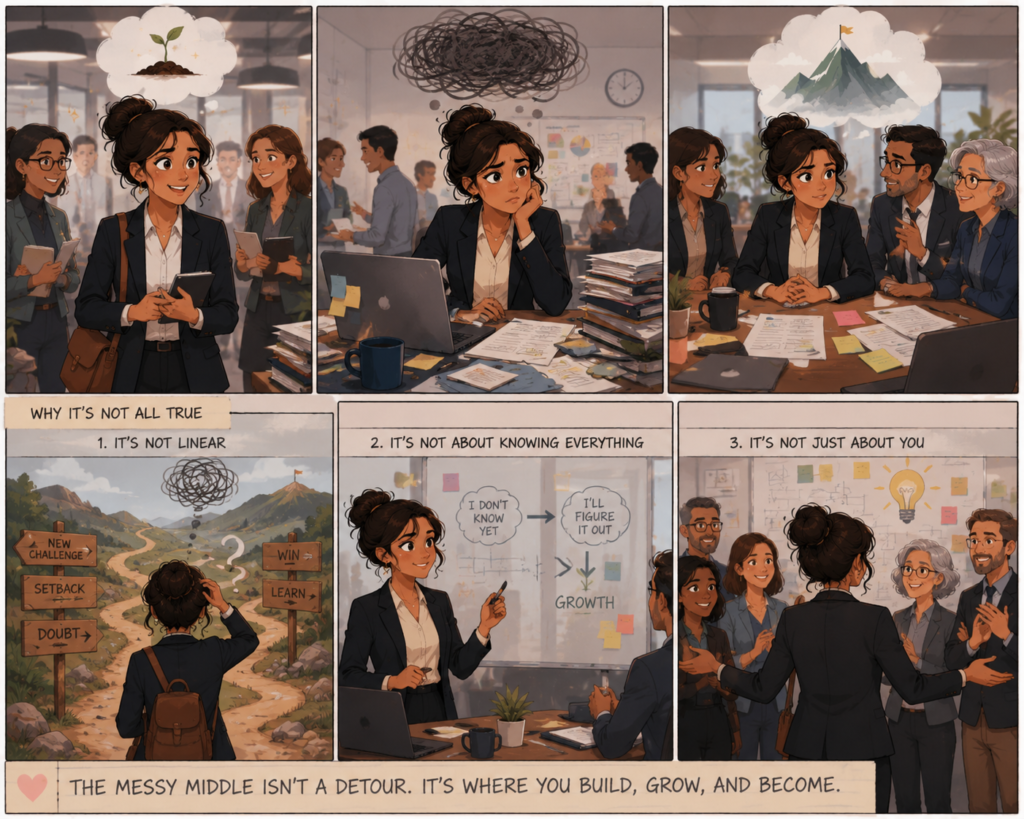
The narrative of the mid-career blues often comes with unhelpful myths:
•Myth: You’re Expected to Know Everything. Reality: No one knows everything. The expectation is often to know how to find answers, how to learn quickly, and how to leverage your experience to solve novel problems. Mid-career professionals bring invaluable judgment and problem-solving skills, not just a static body of knowledge.
•Myth: You’re Stuck. Reality: This phase is an invitation for transformation, not a trap. It’s an opportunity to pivot, refine, or even reinvent your career in a way that aligns more deeply with who you’ve become. Many professionals find their most fulfilling work after navigating this period of introspection.
•Myth: Discomfort Means Failure. Reality: Discomfort is often a signal for growth. The restlessness you feel is not a sign of failure but an indication that something deeper is asking for attention. It’s a developmental stage, not a breakdown.
Conclusion: Your Next Chapter Awaits

The mid-career blues, while challenging, can be a powerful catalyst for profound personal and professional growth. By acknowledging your feelings, actively engaging in self-reflection, and seeking support, you can transform this period of uncertainty into an opportunity for clarity, renewed purpose, and a career that truly energizes and fulfills you. Your journey is far from over; in fact, your most authentic and impactful chapter might just be beginning.